Introduction
The software development landscape in 2024–2025 is undergoing rapid transformation. Across the United States, Europe, and Israel, high-tech industries are embracing new methodologies, tools, and technologies while integrating artificial intelligence (AI) at unprecedented levels. This report presents an overview of major trends shaping software development, how AI is being woven into workflows and products, the evolving role of developers in an AI-driven era, and the key skills fresh computer science graduates will need by 2028. The insights draw on authoritative industry surveys, thought leaders, and institutional reports, providing a broad perspective on where software development is headed.
Major trends in methodologies, tools, and technologies
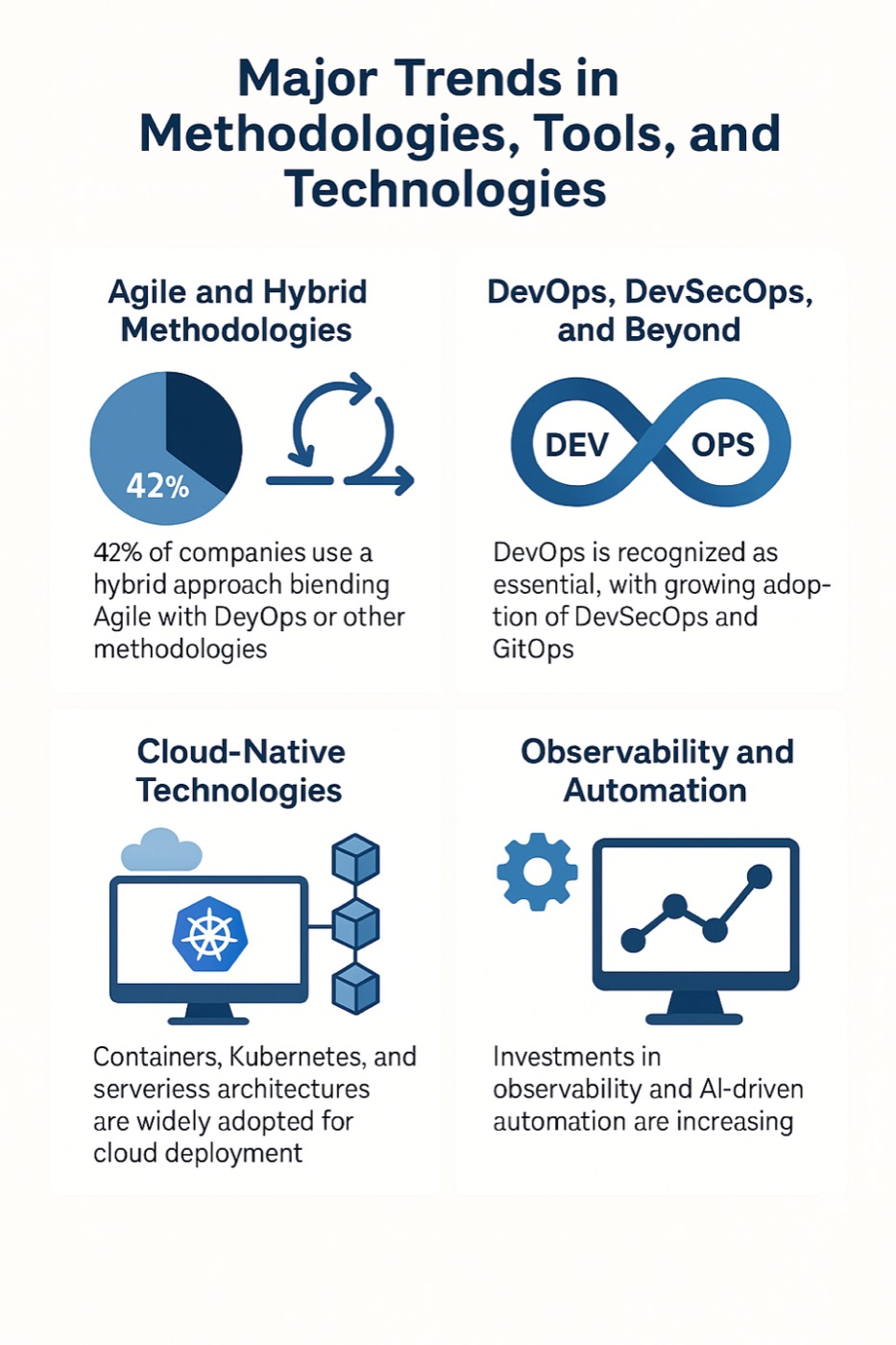
Agile and hybrid methodologies: Agile remains a dominant software development methodology, but many organizations are tailoring it into hybrid frameworks. In fact, about 42% of companies report using a hybrid model that blends Agile with DevOps or other approaches. Larger enterprises (nearly half) are especially likely to use custom hybrids, combining Agile’s iterative development with the stability of other frameworks. This reflects a pragmatic adaptation – while smaller firms still find pure Agile effective, medium and large organizations increasingly mix methodologies to handle remote collaboration, compliance requirements, and legacy systems. Agile’s core values persist, but its implementation is more flexible than ever.
DevOps, DevSecOps, and beyond: DevOps has become mainstream in high-tech. An estimated 86% of organizations worldwide recognize DevOps as essential, and around 80% have actively adopted DevOps practices. In 2024, DevOps continues to evolve, emphasizing closer integration of development and IT operations for faster delivery and reliability. New extensions like DevSecOps (baking in security from the start) and GitOps (using Git for infrastructure as code) are gaining wide adoption. GitOps, for example, is now reaching the mainstream as companies seek more consistent, auditable infrastructure management through version control. Similarly, Platform Engineering principles are on the rise – leading tech firms (Netflix, Uber, Airbnb) have dedicated platform teams that provide standardized environments and self-service tools to development teams. This platform-centric approach boosts reuse and developer velocity at scale.
Cloud-Native Technologies: Cloud computing remains a cornerstone of modern software development. Enterprises are heavily investing in cloud services and multi-cloud strategies, which in turn drive the adoption of containerization and orchestration tools. Containers and Kubernetes have “cemented their position as the deployment standard in most organizations”. As applications span hybrid and multi-cloud environments, Kubernetes offers portability and scalability, making it indispensable for managing distributed systems. The use of Infrastructure as Code (IaC) tools like Terraform is also growing, enabling teams to script and version-control their infrastructure setups similar to application code. Moreover, Serverless architectures are surging in popularity. Functions-as-a-Service (like AWS Lambda, Azure Functions, Google Cloud Functions) allow developers to deploy code without managing servers, auto-scaling with demand. This “serverless revolution” lets developers focus on code and business logic, while the platform handles scaling, resulting in faster experimentation and reduced operations overhead.
Observability and Automation: Modern systems have grown too complex for traditional monitoring alone. Observability – the practice of achieving deep visibility into systems (logs, metrics, traces) – has become mandatory for reliable digital services. In 2024–2025, teams are investing in robust observability stacks to quickly diagnose issues across microservices, distributed cloud infrastructure, and networks. Alongside this, Autonomous and No-Ops trends are emerging. AI-driven automation is increasingly handling routine operational tasks (for example, auto-healing of incidents, intelligent alerting, and capacity optimization). The goal of “NoOps” – minimal human intervention in operations – is gaining momentum, alleviating the burden of managing large-scale systems by delegating more to intelligent software. While human oversight remains crucial, routine deploy, test, and monitoring tasks are being automated to improve speed and reduce errors.
Security and Compliance Built-in: With cyber threats on the rise, integrating security into development workflows is now standard. Intelligent Security Orchestration tools (e.g., SOAR – Security Orchestration, Automation, and Response) are being adopted to automate incident response and threat detection, using machine learning to identify anomalies. “Shifting left” on security is a key theme: development teams employ static and dynamic application security testing (SAST/DAST) earlier in the lifecycle, and Cloud Security Posture Management tools monitor configurations continuously. This trend is global – from the U.S. to Israel and the EU, regulators and enterprises alike are pushing for higher security standards. In EMEA, for instance, new cybersecurity frameworks and data protection regulations (such as the EU’s GDPR and forthcoming AI Act) force companies to bake compliance into software from design time. As Deloitte notes, tech companies in 2024 are “reckoning with regulations” worldwide, responding to government scrutiny over data privacy, AI ethics, and platform accountability. Thus, successful development teams increasingly operate at the intersection of technology and regulatory compliance.
Growth of Low-Code/No-Code: Another notable trend is the democratization of software development through low-code and no-code platforms. These tools enable faster application creation with visual interfaces and minimal hand-coding. Analysts project that by 2025, over 70% of new software applications will involve low-code/no-code tools. This shift is empowering “citizen developers” (often domain experts outside of IT) to build or augment applications, easing the pressure of developer shortages. Large enterprises are embracing low-code for rapid prototyping and to modernize legacy systems quickly. Integration with AI is also emerging in this space – many low-code platforms now include AI assistants to help generate forms, suggest workflows, or even create initial code, further speeding up development. While professional software engineers are still needed for complex and core systems, they are increasingly tasked with overseeing these platforms, setting guardrails, and integrating low-code creations with traditional codebases.
Rise of 'vibecoding' tools in 2025
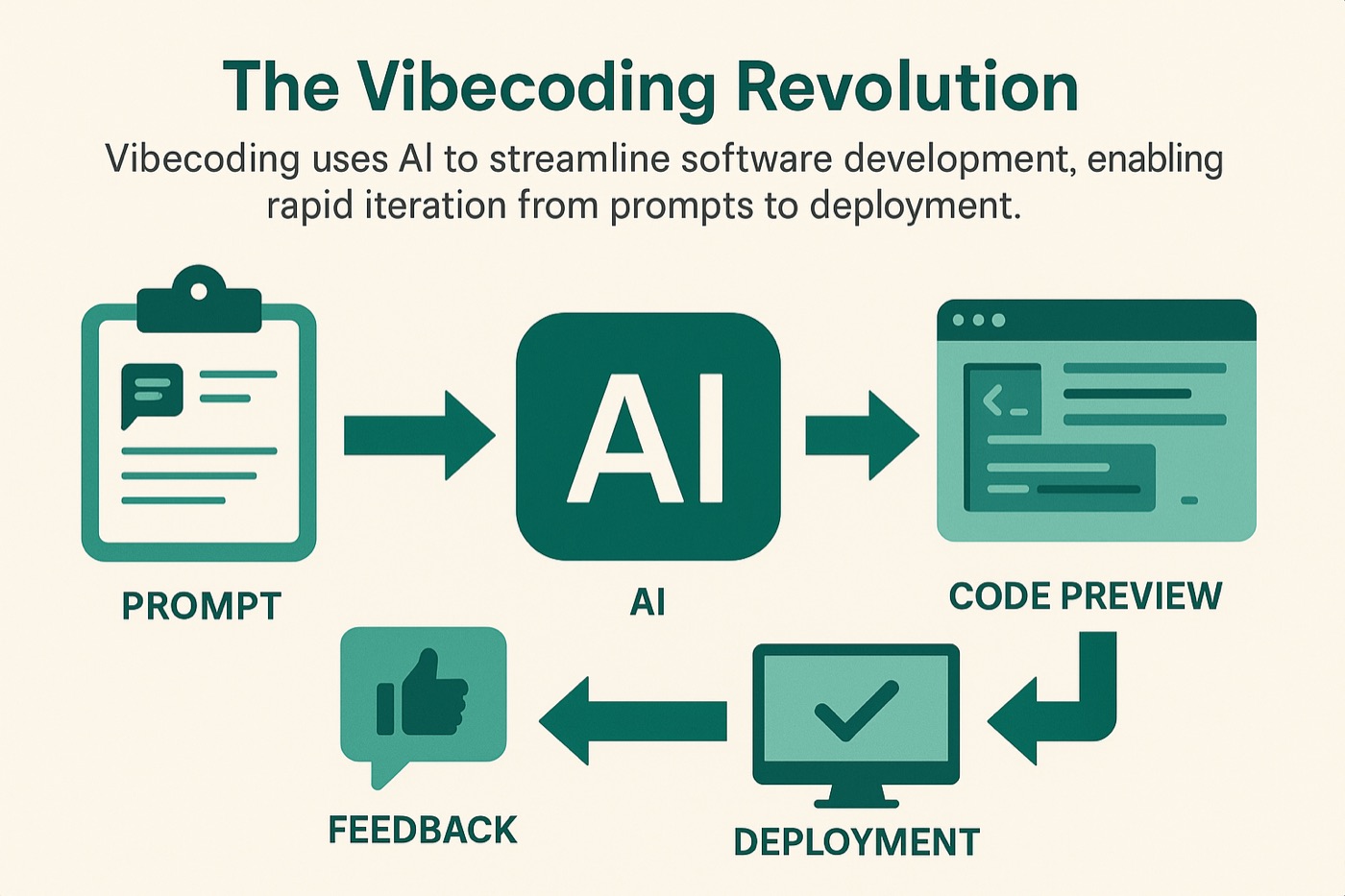
In early 2025, vibecoding (a term introduced by AI expert Andrej Karpathy) exploded onto the software scene. Vibecoding refers to developing software by simply “vibing” with an AI – describing what you want in natural language and letting AI generate the code. This approach shifts the focus from low-level coding to high-level creativity, enabling rapid prototyping and app creation from simple prompts. It’s essentially coding by conversation: developers (or even non-developers) act as “code directors”, guiding an AI to implement features instead of writing each line themselves. This paradigm is powered by advanced large language models (like OpenAI’s Codex, ChatGPT, Claude, etc.), which have become surprisingly adept at understanding a project’s intent from conversational context. By March 2025, vibecoding was more than a buzzword – it was a Silicon Valley “overnight buzz” with industry leaders predicting AI might write “nearly all code within months”, making vibecoding a critical emerging skill.
Leading Vibecoding Platforms (2025): A number of dedicated AI coding tools and platforms have arisen to capitalize on this trend. Each has unique strengths and caters to different audiences in the development community:
Cursor: A specialized fork of VS Code enhanced with an AI assistant (“Composer”) for code generation, editing, and debugging. Cursor supports multiple AI models and allows iterative development where the AI suggests changes and the developer reviews them before application. It’s popular among experienced developers looking to integrate AI into their existing workflow, providing control and precision in complex projects.
Windsurf: An AI-powered IDE (from Codeium) aimed at keeping developers in the flow state. Windsurf provides real-time proactive code suggestions and even voice integration for hands-free coding. Its “Cascade” feature lets the AI handle multi-file edits coherently, making it ideal for rapid prototyping and intuitive development. Developers appreciate its hands-off approach – it anticipates needs so you can focus on higher-level design.
Lovable: A beginner-friendly platform that “democratizes coding”. Lovable offers a two-pane interface: on one side you chat with an AI about what you want, and on the other you see a live preview of your app taking shape. It’s geared toward non-coders or product designers – people who have ideas but lack programming skills. In early 2025 it was free (beta) and attracted a large user base by making web app creation as easy as texting. Lovable emphasizes ease of use, with features like click-to-select UI elements and built-in connections to common services (Stripe for payments, Supabase for data) to guide users step-by-step.
Bolt: A reboot of the StackBlitz online IDE, Bolt is built for speed and simplicity in web development. It runs entirely in the browser and lets you “prompt, run, edit, and deploy” full-stack web/mobile apps in one place. Bolt shines at instant front-end prototypes – you can even import a Figma design and have Bolt generate a matching UI. Its tight integration of prompting and live deployment makes it a favorite for hackathons, quick demos, and startups that want to ship minimum viable products (MVPs) in record time.
V0: Vercel’s entry into vibecoding, V0 focuses on a seamless path from idea to deployment within the Vercel ecosystem. It hasn’t fully matured as of 2025 (details were still emerging), but its promise lies in leveraging Vercel’s popular hosting pipeline. For developers already using Vercel for their web apps, V0 aims to let them describe a feature and have it built and deployed in one go, tightly integrated with Vercel’s tooling.
These platforms experienced surging adoption in 2025. For example, Lovable reportedly hit $17M in annual recurring revenue (ARR) within three months of launch, indicating significant user uptake. Windsurf likewise reached about $40M ARR and began targeting enterprise teams (not just individual devs). The fact that even beta-stage tools amassed tens of thousands of users highlights how quickly vibecoding captured the industry’s imagination. Traditional code editors in 2024 were all about manual keystrokes, but by 2025 many developers had at least experimented with vibecoding agents in their workflow.
Vibecoding tools are transforming how software is built. Instead of grinding through boilerplate code and setup, developers can achieve functional prototypes in hours rather than days. Studies in 2025 found that AI-assisted coding made developers 81% more productive on average, with workflows 55% faster than before. Teams using these tools describe a shift in mindset: they spend less time on syntax and debugging minutiae, and more time on system design, user experience, and “big picture” thinking. In other words, the developer’s role is evolving from a coder who writes line-by-line, to a guide or architect who tells the AI what to build and then fine-tunes how it should work. This “code director” role lets humans focus on creative and complex aspects (like choosing architectures, ensuring security, defining features), while delegating repetitive or generic coding tasks to the AI. Even non-programmers are empowered: with vibecoding, a startup founder with no coding background can spin up a working web app by simply describing their vision to Bolt or Lovable. This has fed a new wave of innovation and experimentation, as the barrier to turning an idea into a demo has never been lower.
Industry adoption of “vibecoding”
Widespread Adoption and Buzz: By mid-2025, vibecoding had become a hot topic across tech forums, news outlets, and boardrooms. A Fortune report captured the hype with a Silicon Valley CEO’s claim that “vibe coding lets 10 engineers do the work of 100”. While perhaps hyperbolic, this statement reflects a real sentiment: early adopters saw dramatic boosts in productivity. Companies embraced vibecoding tools to accelerate development timelines and alleviate talent shortages by enabling smaller teams to output more software. OpenAI’s leadership even hinted that we are on the cusp of AI writing virtually all routine code, which spurred many engineers to start “vibing” with AI or risk being left behind. According to The New Stack, AI coding agents are “blending product thinking with rapid implementation”, fundamentally reshaping engineering roles. In practical terms, this means developers must think more about what to build (product/design mindset) while trusting the AI to handle how to build it at the code level.
Crucially, the impact isn’t just speed – it’s also changing software culture. Accepting AI-written code without fully understanding it is becoming more common (sometimes phrased as “coding on vibes”). This has raised eyebrows among veteran engineers. An Ars Technica piece posed the provocative question: “Will the future of software development run on vibes?” – capturing both excitement and concern. On one hand, vibecoding is “gnarly” and empowering; on the other, it can be “reckless” if developers deploy code they don’t grok. Some experts laud vibecoding for democratizing development and speeding up innovation. Others caution that churning out code via AI is “the fastest ever way to build technical debt” if used carelessly. Steve Jones, a software architect, wryly noted that “never in the history of IT have we been able to do stupid things as fast” – warning that if teams skip proper design and testing, vibecoding could lead to brittle systems.
Quality and Limitations: In practice, these AI tools still have limitations that temper the hype. AI-generated code can be messy, non-optimal, or hard to maintain, especially if the prompt didn’t specify quality constraints. Thoughtworks engineers conducted experiments to see if vibecoding can produce production-grade software – their conclusion: “not consistently – not yet.”. They found that an AI can scaffold a decent app quickly (often getting ~80% of the way to a functioning concept), but the remaining 20% (polish, robustness, edge-case handling) still requires strong human intervention. One key issue is context: unless carefully guided, AI agents may lose track of project context in long sessions, requiring developers to reiterate details (a bit like an intern with short memory). There’s also a trust factor – seasoned engineers are learning that they must verify every AI-produced output. As one expert put it, software development with AI becomes “a verification process rather than a creation process”. You cannot assume AI code is correct; you have to test and review it just as you would a junior developer’s work. In fact, developers who treat the AI as a “junior pair programmer” and actively ask clarifying questions, set architectural guidelines, and write tests get much better outcomes than those who just accept the first answer. Human oversight and deliberate prompting (e.g. asking the AI to follow certain design patterns or writing unit tests) dramatically improve the quality of AI-generated code.
Despite these challenges, the overall trajectory of vibecoding tools is very positive. Advocates argue that far from replacing human developers, these AI agents act as co-pilots – “boosting creativity and productivity without replacing the human touch.” The AI handles the boilerplate and grunt work, but human ingenuity, critical thinking, and problem-solving remain indispensable. In fact, IBM’s AI experts stress that while vibecoding automates a lot, “true creativity and out-of-the-box thinking remain uniquely human,” so a developer’s input and oversight “cannot be overridden.”. Thought leaders predict that as the tech matures, we’ll see more “AI agents” that can take on larger chunks of a project autonomously, possibly running in parallel (one agent coding a feature while another writes tests, etc.). This could multiply productivity even further – some AI agents in 2025 were already as productive as a human developer at a fraction of the cost. However, this only heightens the need for skilled developers to orchestrate, validate, and maintain these AI-driven codebases. As Ars Technica quipped, the future of coding may well “run on vibes,” but it will require “vibe checks” – i.e. vigilant human supervision to ensure those AI-generated solutions are reliable and secure.
Regional spotlights
Across regions, these trends manifest with local flavor. In Israel, a global tech hub, AI is the standout focus: 63% of Israeli tech industry leaders identified artificial intelligence as the most noteworthy tech trend for 2024. The country’s high-tech sector, known for cybersecurity and deep-tech startups, is rapidly infusing AI into products and dev processes. Europe, on the other hand, is emphasizing digital skill development and open-source collaboration. The EU has set ambitious targets for digital literacy (aiming for 80% of adults with basic digital skills by 2030) and actively promotes open-source software as a foundation of its tech ecosystem. European industries are keen on sustainable software practices and data sovereignty – trends reflected in increased adoption of open-source and adherence to strict data regulations. In the United States, large tech firms are doubling down on cloud and AI investments. Enterprise spending on software in the U.S. is especially directed towards AI, cloud services, and cybersecurity, which are expected to drive most of the tech market growth in 2024. U.S. companies also lead in experimenting with generative AI applications and in scaling DevOps automation across massive cloud infrastructures. Despite different emphases, collaboration and knowledge-sharing across these regions remain high, aligning global software development trends more than ever before.
AI’s expanding role in software development workflows and products
Artificial intelligence has moved from a niche experiment to a core component of software development in 2024–2025. Developers are increasingly leveraging AI throughout the development lifecycle, and companies are embedding AI into their products at scale.
AI-Powered Development Tools: A remarkable shift is the widespread use of AI as a “coding assistant”. Modern IDEs and editors now integrate AI-driven features that can generate code, auto-complete functions, find bugs, and even write tests. According to the 2024 Stack Overflow Developer Survey, 76% of all developers have already used or plan to use AI tools in their development process, up from 70% the year before. In practice, a solid majority (over 61%) of developers are currently using AI for coding help, with another sizable portion planning to start soon. A GitHub survey of enterprise developers in 2023 painted an even more dramatic picture: 92% of U.S.-based developers at large companies reported using AI-powered coding tools in their work. These AI helpers range from general-purpose models like OpenAI’s ChatGPT (used to explain code or suggest approaches) to specialized tools like GitHub Copilot, Amazon CodeWhisperer, and Tabnine that are trained on coding patterns. Developers use AI assistance for various tasks: generating boilerplate code, refactoring legacy code, suggesting algorithmic solutions, and even producing documentation. Notably, writing code is the top use case (about 82% of developers using AI tools leverage them to write or complete code snippets). AI is also helping with debugging and error fixing by analyzing error messages and proposing solutions, which speeds up the troubleshoot cycle.
The integration of AI is not limited to coding tasks. AI is streamlining software testing through intelligent test case generation and automated detection of anomalies. It’s also used in code review – tools can automatically detect common flaws or suggest improvements in pull requests. All these contributions add up to significant productivity gains. Studies have found that developers using AI assistants produce more output – for instance, one report noted a 13.5% increase in code commits and a 38% faster compilation rate when AI assistance is in play. GitHub’s own metrics indicate developers with Copilot feel their work is more satisfying and that they code significantly faster (over 50% faster in some cases). These efficiencies allow engineers to focus more on high-level problem solving and creative design, as mundane tasks are offloaded to AI.
Generative AI in Software Products: Beyond the development process itself, AI is being deeply integrated into the software products and services that companies deliver. From smart features in applications (like AI-driven recommendations, natural language interfaces, or predictive analytics) to entirely new AI-centric services (such as AI-powered chatbots, image generators, or autonomous systems), generative AI is a key selling point of many modern software offerings. Nearly half (49%) of technology leaders surveyed in late 2024 said AI is “fully integrated” into their company’s core business strategy, and one-third reported that AI is already fully embedded in their products and services. In practice, this means many new applications coming to market have AI components: e.g., a mobile app might use AI for voice recognition and personalization, a SaaS platform might incorporate AI analytics dashboards, and enterprise software often includes AI-driven automation of workflows.
Industries across the US, EU, and Israel are leveraging AI capabilities appropriate to their domains. For example, European firms often tout “trustworthy AI” features, aligning with EU regulations – focusing on explainability and compliance in AI-driven software (like financial or healthcare applications that use AI but need to demonstrate fairness and transparency). Israeli startups, frequently in cybersecurity and fintech, embed AI to detect threats or fraud in real-time. U.S. tech giants are integrating generative AI as core features (think of large language model APIs being part of cloud platforms, or AI enhancing office productivity suites and developer tools). This cross-cutting presence of AI means that software developers now frequently work with machine learning models – calling AI APIs, fine-tuning models on data, or handling model outputs – as part of building “ordinary” software. The result is a blurring line between traditional software engineering and AI development. Many teams now operate in a “MLOps” fashion, where the deployment pipeline includes not just code, but also data pipelines and model versioning.
AI for Project Management and DevOps: Another area where AI is making inroads is in project management and operations (often termed AI Ops or Software Engineering Intelligence). AI-driven analytics platforms can analyze development workflows to identify bottlenecks – for example, measuring how long code sits waiting for review or how frequently builds fail – and suggest improvements. According to Gartner, by 2027, 50% of software engineering organizations will be using AI-driven software engineering intelligence platforms to improve productivity, a huge jump from only 5% in 2024. These platforms might use machine learning to forecast project timelines, automatically assign issues to the best-suited developers, or optimize CI/CD pipeline performance. In DevOps, AI-based tools are optimizing cloud costs and resources (by predicting traffic and scaling up/down automatically) and performing incident management (by correlating logs and alerts to pinpoint root causes). The push towards autonomous operations mentioned earlier is largely powered by these AI techniques. Essentially, AI acts as a smart assistant not only to individual developers but to the team as a whole, observing patterns and helping coordinate the complex dance of modern software delivery.
Challenges and Considerations: With AI’s growing role, developers and organizations have new factors to consider. One concern is ensuring AI suggestions or generated code are correct and secure. AI models can sometimes produce insecure code or subtle bugs, so developers must review AI output carefully. There are also intellectual property questions (since models like Copilot are trained on public code, developers wonder about code license compliance). Moreover, the ethical dimension of AI in products is paramount: companies need to prevent bias in AI features and adhere to emerging AI regulations (Europe’s forthcoming AI Act will require risk assessments and transparency for AI systems). Despite these challenges, the overall trend is clear – AI has become an indispensable part of the software developer’s toolkit and a driving force in what software products can do.
The changing role of software developers in the age of AI
As AI automates aspects of coding and software operations, the role of software developers is fundamentally evolving. Rather than being replaced, developers are adapting to work alongside AI – effectively becoming AI-augmented developers. This shift is changing the skills and profile of who gets hired and how software teams operate.
From coding to orchestrating: Traditionally, a developer’s value was measured by their coding prowess and knowledge of frameworks. While programming fundamentals are still crucial, AI is transforming coding from a purely technical task into more of a multidisciplinary, orchestration role. A popular saying has emerged: “AI won’t replace developers, but developers who leverage AI will replace those who don’t.” In practice, this means programmers must now excel at directing and supervising AI tools rather than just writing code manually. Industry leaders note that coding today “is not just about knowing code – it’s about understanding user experience, data, and human psychology”, especially because AI systems aim to simulate aspects of human thinking. Uzi Yaari, a VP at an Israeli software firm, emphasizes that the best programmers now think like users and consider behavioral aspects, since they often design how an AI will interact with people. In other words, developers need a broader worldview: understanding how humans make decisions, and how to incorporate those insights into AI-driven features.
New responsibilities – “AI Managers”: As AI becomes a co-developer, software engineers take on a management and quality control role over AI-generated output. Amir Ish-Shalom, VP of R&D at Lightrun, describes that to work effectively with advanced code-generating AI, “you need to explain the architectural design of the product to the AI system at a higher level. It’s like having four junior developers working for you”. In this analogy, the developer is in charge of guiding multiple AI “agents” – for instance, one might generate code, another writes unit tests, another creates documentation. The developer must clearly communicate goals and constraints to these AIs (much like one would mentor junior devs) and then integrate their outputs. This requires architectural thinking and the ability to break down a project into tasks that an AI can tackle. It also requires vigilance: Ish-Shalom notes that less experienced devs sometimes rely too heavily on AI and end up with code they don’t fully understand, causing bugs and delays down the line. Therefore, a senior developer’s role now includes ensuring that AI-generated code meets quality standards and fits the product’s requirements – essentially debugging and curating AI outputs. Some organizations have even introduced the concept of an “AI Engineer” or “Prompt Engineer” who specializes in crafting the right prompts and processes to get the most out of AI tools.
Skill shift – emphasis on soft skills and systems thinking: Because routine coding can be partly automated, the uniquely human skills of developers are coming to the forefront. Employers now place high value on communication, collaboration, and adaptability. A recent Israeli high-tech survey noted that the requirements for developers extend beyond technical knowledge and AI tool familiarity, highlighting the need for management and teamwork skills, a capacity to quickly learn new tools, and a broad analytical mindset. In team settings, developers collaborate with more people (enterprise devs often work with 20+ other engineers on a project), and they also collaborate with AI systems. This means effective communication – explaining ideas clearly to teammates and also to AI tools – is critical. Mentoring ability is prized: top developers are those who “naturally want to teach and develop others” and can even build tools to help others, which multiplies team productivity. This mentoring mindset now extends to mentoring AI as well (guiding its learning/outcomes). Resilience and adaptability are highlighted as key traits, since the tech landscape changes rapidly and AI tools themselves evolve. Developers must be ready to continuously learn and handle change – whether it’s adopting a new framework or adjusting to an AI’s quirks.
Additionally, developers are expected to think at a higher abstraction level. They need to exercise conceptual and systems thinking, envisioning how all parts of a project fit together and might evolve. With AI handling many micro-tasks, a developer’s job is increasingly to define the overall structure and logic – the “big picture”. Grady Booch, a veteran software engineering thought leader, put it succinctly: “AI is going to fundamentally change what it means to be a programmer. It won’t eliminate programmers, but it will require them to develop new skills and work in new ways.” Developers now often operate on a three-tier model of skills: at the base, strong coding and computer science fundamentals; in the middle, data science and data engineering literacy; at the top, expertise in machine learning algorithms. Mastery of algorithms and understanding how AI models work (e.g. knowing the basics of neural networks, NLP, etc.) equips developers to effectively incorporate AI into applications and to question AI outputs critically. Liron Prizant, an HR VP at Agmatix, stresses that critical thinking – questioning how an AI model was trained, what data was used, and evaluating its impact – is now crucial for developers.
AI as a partner, not a replacement: It’s worth noting that despite AI’s rapid advancement, the consensus is that human developers remain essential. AI may write code, but humans still must define the problems, guide the solutions, and ensure ethical, user-friendly outcomes. A McKinsey analysis suggests that even with AI automation, roughly 80% of programming jobs will remain human-centric in the coming years. What’s changing is the distribution of tasks: mundane coding or maintenance work might shrink, while the creative, analytical, and integrative aspects of development take a larger share of a developer’s time. Developers are evolving into problem solvers and innovators who use AI as one of many tools. In recruitment, this is reflected by companies screening for an “AI mindset” – not just the ability to use AI tools, but the knack for identifying where AI can add value and how to incorporate it into workflows. Fresh job postings for software engineers increasingly mention experience with AI APIs, familiarity with machine learning, or at least a demonstrated interest in AI-driven development, even if the role isn’t explicitly an AI engineer. In summary, AI has shifted the developer’s role from primarily code producer to a combination of architect, validator, and collaborator. Developers who embrace this expanded role – combining technical expertise with strategic thinking and people skills – are thriving in the AI-augmented software industry.
Skills new graduates will need by 2028
Looking ahead to 2028, what skills should a fresh computer science (CS) graduate have to succeed in the general tech industry? Given the trends outlined, companies will seek well-rounded engineers who are not only technically proficient but also adaptable and AI-savvy. Below is a summary of key skills and competencies expected to be in high demand for graduates entering software development roles in the next few years:
Strong Programming Fundamentals
Are core programming fundamentals becoming less important? On the surface, one might think so. If AI can generate code from a prompt, do young developers still need to master algorithms, data structures, optimization, or debugging? Interestingly, industry experts overwhelmingly say fundamentals are as important as ever – if not more. The nature of their application is what’s evolving. In a vibecoding world, a junior developer may not spend all day hand-coding every function. Instead, they spend more time reviewing AI-produced code, diagnosing why a suggested solution isn’t working, or formulating a better prompt to fix a bug. This means a solid grounding in programming concepts and computer science theory is crucial to understand and guide the AI’s output. As a Thoughtworks report put it, achieving production-grade results with AI required deliberately reinforcing software quality principles – ensuring things like modular design, testability, and scalability – through the prompts and through human oversight. An AI won’t automatically enforce clean architecture or efficient algorithms unless you, the developer, know to ask for it. Graduates who have a strong grasp of CS fundamentals will be better at spotting when the AI’s code is suboptimal or incorrect, and then steering it in the right direction.
“Software development with AI becomes a verification process rather than a creation process”, one expert noted, emphasizing that developers are still accountable for correctness. In practice, this means you can’t blindly trust AI output – you must test and verify it using your knowledge of how good code works. New grads will be expected to exercise solid debugging skills and logical reasoning to vet AI-generated code. As another seasoned architect quipped, vibecoding that “looks good” at first glance can hide serious issues if you don’t understand what the code is doing. Employers will want assurance that a candidate can read a block of AI-written code and explain or fix it – a task impossible without foundational coding knowledge.
Furthermore, while rote memorization of syntax might diminish in importance (since AI can provide the exact syntax on demand), the ability to conceptualize algorithms and data flow is paramount. Some foresee that developers can “deprioritize programming language syntax” in their learning, letting the AI handle boilerplate, and instead focus on higher-level problem solving. Even if syntax memorization wanes, understanding why a certain algorithm is needed, or when to use a particular data structure, is still vital. By 2028, many employers will likely adjust their interview techniques to reflect this shift – rather than asking candidates to code brute-force solutions on a whiteboard, they may present an AI-generated solution and ask the candidate to improve it or catch bugs in it, testing their fundamental understanding. In summary, strong programming fundamentals are not becoming less important due to vibecoding – they are evolving from being about manual coding proficiency to being about strategic coding competence. Grads will need deep knowledge of how software works in order to architect systems at a high level and to ensure the AI’s contributions are correct, efficient, and secure. As one commentary noted, vibecoding might get you 80% of a working app on “vibes,” but the last 20% – making it reliable and robust – still demands solid software engineering skills. Far from making fundamentals obsolete, the AI revolution is “raising the bar” for developers to apply those fundamentals in more analytical and oversight-oriented ways.
AI Literacy
In 2025, vibecoding itself became a “critical skill”, and by 2028 this will likely be a core expectation for CS graduates. AI literacy is only growing in importance. This doesn’t necessarily mean every developer must be a machine learning researcher, but it does mean being fluent in the ecosystem of AI tools and concepts. Employers will look for new grads who know how to collaborate with AI in the development process. For example, being able to use tools like GitHub Copilot, Cursor, or Replit’s AI effectively – i.e. knowing how to craft good prompts, how to refine those prompts iteratively, and how to handle AI “hallucinations” or errors – will be a valued skill. In Thoughtworks’ advice, developers should “start experimenting” with guiding AI tools, learning to frame prompts with architectural guidelines and testing strategies. This kind of AI-augmented development savvy will likely become as fundamental as knowing a programming language. We can think of prompt engineering as the new must-have skill: the ability to communicate your intentions to an AI in a way that yields useful results. Indeed, industry experts recommend learning prompt engineering and vibecoding techniques “properly instead of resisting it,” likening it to learning a powerful new tool like riding a motorcycle – initially bumpy, but transformative once mastered.
Beyond using AI coding assistants, broader AI literacy – understanding how machine learning models work, their limitations, and how they are deployed – will also be increasingly expected. By 2028, many software projects will incorporate AI components (for example, an app with a built-in recommendation model or an AI-driven feature). A CS graduate doesn’t necessarily need to build a neural network from scratch, but they should at least understand concepts like model training, evaluation, bias, and data requirements. This literacy enables them to intelligently use AI services and to troubleshoot issues. It also helps in making strategic decisions: e.g. knowing when to use a pre-built model vs. train a custom one, or understanding why a coding assistant might be producing flawed output (maybe the prompt is ambiguous or the model lacks domain knowledge).
Crucially, AI literacy also encompasses ethical and effective use of AI. Employers will expect new hires to be aware of things like AI bias, security implications of AI-generated code, and intellectual property issues (since AI can inadvertently regurgitate licensed code). For instance, a vibecoding developer must ensure that the AI didn’t introduce a security vulnerability – which requires knowledge of secure coding fundamentals (tying back to skill #1) and understanding that the AI doesn’t guarantee security out of the box.
In essence, AI literacy is becoming more important and more mainstream. A telling quote comes from an AI engineering leader who suggested “all engineers should know [AI engineering] inside out” – implying that familiarity with how AI models function and how to integrate them is becoming part of the standard toolkit. We’re already seeing curricula changes in universities to include AI-assisted development and prompt design. By 2028, a CS grad who has never used an AI coding tool would be seen as behind the times, much like a grad today who has never used source control. On the flip side, those who excel at leveraging AI will stand out. They’ll be the ones who can multiply a team’s output, much like the “10x engineers” of the past, except now the “x” is achieved by smart use of AI co-workers. As Fortune noted, ten “vibe coders” can potentially achieve what fifty traditional engineers might – so companies will highly value those vibe-savvy developers. In summary, expect AI fluency to be a core hiring criterion: employers will want proof that you can work effectively in this AI-rich development environment (for example, internship experience with AI tools, or personal projects showcasing AI integration). AI is not replacing developers; developers who know how to harness AI are replacing those who don’t.
Data Analytics Skills
In the era of vibecoding, data-centric skills remain crucial – in fact, they are becoming increasingly intertwined with software development. Here’s why: AI-driven development still fundamentally runs on data. Whether it’s the data used to train the models, the data your application processes, or the analytics data that guides product decisions, a successful developer needs a good handle on data science and analytics. For 2028 graduates, we anticipate that employers will put heightened emphasis on data literacy alongside traditional coding skills.
Data in AI Development: First, building and maintaining AI-powered applications often requires knowledge of data engineering. A LinkedIn tech career guide suggests new developers “focus on pipeline design, big data tools, and analytics”, noting these are valuable especially for roles in AI research and MLOps. This means that even if your job title is “software engineer,” you might need to set up data pipelines or work with cloud data platforms in order to feed your AI components the information they need or to analyze application outputs. By 2028, it’s likely that a CS curriculum (or a new grad’s skillset) includes familiarity with databases, data processing frameworks, and maybe even basics of building data workflows (ETL – extract, transform, load – processes). Employers will expect that you can not only write an app, but also handle the data that powers the app. For instance, if you help develop an AI-driven e-commerce site, you might be expected to know how to query the sales database and perform an analysis of user behavior to refine a recommendation algorithm.
Analytics and Decision-Making: Moreover, as vibecoding automates coding tasks, analytical thinking becomes a key differentiator for human developers. Since AI can churn out code quickly, the competitive edge shifts to those who can decide wisely what to build next and how to interpret results. A new grad who is comfortable with data analysis can bring extra value by deriving insights from user data or system metrics. Companies love developers who can measure and improve things – e.g. analyze A/B test results, optimize a funnel by looking at analytics, or even use data to debug (like examining logs and statistics to pinpoint a performance bottleneck). These are skills that overlap with data science. We expect employers to increasingly seek candidates who, for example, know some SQL, can make simple data visualizations, or understand basic statistics to validate experiments.
Human Judgment in Data: Importantly, while vibecoding tools might handle “boring, repetitive parts” of coding (including some routine data handling), they do not replace human judgment in analysis. AI might generate a script to clean data or perform a calculation, but a human needs to ensure the analysis is correct and meaningful. By 2028, grads should be adept at asking the right questions of data. If an AI generates a dashboard, can the developer interpret it correctly and spot anomalies? If an AI suggests a machine learning model’s output, does the developer understand the metrics (accuracy, recall, etc.) and limitations? These higher-level analytical skills ensure that the presence of AI leads to informed decisions rather than blind trust. Employers will likely quiz candidates on scenario-based questions like: “If our AI model’s recommendation system seems to be favoring one category of product too much, how would you investigate that?” – a question testing both technical data skills and critical thinking.
In sum, data science and analytics skills are only becoming more important for CS grads. The nature of these skills might shift slightly – for example, you might rely on AI to do initial data crunching, but you’ll focus on interpreting and refining that output. Or you might use automated tools to monitor system data, but you’ll be responsible for setting the right metrics and reacting to them. We foresee that a 2028 grad with a strong foundation in data (maybe who has taken courses in statistics, machine learning, or data mining) will be highly attractive to employers. They bring the ability to bridge the gap between raw data and business value, an ability amplified by vibecoding tools that let them quickly implement data-driven features. In a world awash with AI-generated code, those who can harness data insights will guide projects in the right direction. After all, building software isn’t just about getting code to run – it’s about solving real problems, often evidenced through data. Grads who can combine coding and analytics will be poised to deliver deeper insights and smarter applications.
Cloud and DevOps Proficiency
Entry-level developers are increasingly expected to be familiar with cloud environments (AWS, Azure, Google Cloud) and DevOps practices. By 2028, cloud will be the default platform for most software. Grads should understand containerization (Docker), possibly orchestration (Kubernetes), and how continuous integration/continuous deployment (CI/CD) pipelines work. Experience with tools like Git for version control, and automation scripts for testing/deployment, is very advantageous. This skillset shows that a new developer can efficiently collaborate in modern, agile teams and not just code in isolation. Given the industry’s push toward infrastructure-as-code and GitOps, understanding how to deploy and maintain software is as important as building it.
Cybersecurity Awareness
With security being “everyone’s responsibility” in development, new engineers need a security-conscious mindset. They should know the basics of secure coding (e.g., avoiding SQL injection, proper input validation, using encryption) and be aware of common vulnerabilities (OWASP top 10). In regions like the EU and U.S., regulatory standards demand data protection and privacy compliance, so developers with knowledge of these areas are valued. Some universities incorporate cybersecurity into CS curricula, and graduates should leverage that. At minimum, familiarity with authentication, authorization, and safe use of third-party libraries will be expected.
Collaboration & Communication
Soft skills are increasingly highlighted by employers. Grads entering the workforce must be able to work effectively in teams, communicate their ideas, and write clear documentation. Agile and DevOps cultures rely on constant communication (daily stand-ups, code reviews, pair programming). Being able to explain one’s thinking and listen to feedback is key. As noted, development has become a team sport – often involving cross-functional collaboration with designers, product managers, and now even AI systems. Thus, interpersonal skills, clarity in writing (for documentation or commenting code), and an attitude of “team first” are vital. Recruiters often test for this via behavioral questions or group exercises.
Adaptability & Continuous Learning
Technology in 2025 and beyond changes at breakneck speed. A fresh graduate must demonstrate the ability to learn new tools and technologies quickly. This includes being open to picking up new programming languages, adapting to new frameworks, or learning an organization’s internal systems. Employers value curiosity and a growth mindset – e.g. a candidate who has self-taught a new technology outside class, or kept up with industry trends. Given how AI is introducing new paradigms, being comfortable with change is crucial. By 2028, roles and tools that don’t even exist today may become common; the graduates who thrive will be those who can continuously upskill themselves. Showing evidence of continuous learning (like online courses, hackathon projects, or contributions to open source) can be a big plus.
System Design & Big-Picture Thinking
Even at a junior level, developers in 2028 should have an understanding of system design basics. This means grasping how different components of a software system interact (front-end, back-end, databases, third-party services, etc.), and thinking about scalability and maintainability. As AI tools take over writing snippets of code, human developers will focus more on designing the overall solution. New grads should practice designing small systems (for example, designing a simple web application architecture) and be prepared to discuss trade-offs. This skill demonstrates an ability to go beyond writing code – it shows problem-solving at a higher level, which is what companies need for long-term project success.
So what?
The vibecoding revolution of 2025 has set the stage for a new era in software development. Tools like Cursor, Windsurf, Lovable, Bolt, and V0 are changing how developers work, making coding more about ideas and less about syntax. By 2028, today’s CS students will enter a job market that expects them to comfortably straddle this human-AI partnership. Strong programming fundamentals will remain the bedrock – not for cranking out rote code, but for architecting systems, verifying AI outputs, and ensuring that fast-produced code is high quality. AI and ML literacy will shift from a niche skill to a core competency: new grads will be expected to wield AI coding assistants expertly and understand machine learning concepts as part of standard development practice. And data science and analytics skills will continue to be in high demand, enabling developers to make data-driven decisions and build intelligent, insight-rich software. In the vibe-driven development world, those who can combine creative vision, technical fundamentals, and analytical thinking will thrive. The tools may change and the AI may handle more of the grunt work, but the essence of what employers seek – problem solvers who can learn, adapt, and deliver value – remains as true as ever, even if now they do it with a little help from their AI friends.
Sources:
Deloitte (2024). Technology Industry Outlook 2024 – Key trends in cloud, AI, and cybersecurity driving growth.
Stack Overflow (2024). Developer Survey – Surge in AI tool usage among developers (76% using or planning to use).
VentureBeat (2023). GitHub Developer Survey Highlights – 92% of developers at large firms use AI coding tools; AI tools boost productivity and collaboration.
Enhops (2024). Top DevOps Trends – Rise of autonomous operations, observability, security automation, platform engineering, GitOps, and serverless in DevOps.
BP3 Global (2023). Low-Code/No-Code Trends for 2024 – Low-code expected to exceed 70% of software development by 2025.
Statista (2023). Israel Tech Industry Trends – 63% of Israeli tech leaders cite AI as the top trend for 2024.
CTech/Calcalist (2025). “AI won’t replace developers – but it will change who gets hired” – Insights on new skill requirements (broad worldview, teamwork, quick learning, AI mindset) for developers in the AI era.
CTech/Calcalist (2025). Changing Role of Developers – Three-tier skill model: coding fundamentals, data science, and AI/algorithms at the top; importance of adaptability and soft skills.
BrainHub (2024). Future of Software Engineers in Age of AI – Gartner and McKinsey projections on AI adoption and the enduring need for human-centric development (80% of dev jobs remain human-centric).
PwC (2024). AI Business Survey – 49% of tech leaders have AI fully integrated in strategy, one-third in products.